
Three Treasures of Good Relationships
Love, Simplicity, and Humility

Hello dear friends, and welcome to the Wednesday Wisdom Newsletter, where I, Sean Waters, share inspiring ideas and tiny experiments in human flourishing. In this edition, co-writing a curriculum on human happiness re: Relational Intelligence. Send me a message or schedule some time with me if you want to chip in. Or, you can become a paid subscriber.
Here’s to the emergent flourishing between us,
“I have three treasures. Guard and keep them:”
Insights from Classical Taoism (~500 BCE)
When I asked to go deeper into R-is-for-Relationships1, I was delighted to be drawn back to chapter 67 in Tao Te Ching, a classic text from Taoism that has its own Wikipedia entry. Here’s the heart of the chapter:2
I have three treasures. Guard and keep them:
The first is deep love,
The second is frugality,
The third is not to dare to be ahead of the world.
Because of deep love, one can be courageous.
Because of frugality, one can be generous.
Because of not daring to be ahead of the world, one becomes the leader of the world.
Keeping these treasures leads to “determination, ease, and guidance.”3 Let’s go a bit deeper.
“The first is deep love,”
(Tz'u). Also translated as compassion, mercy, kindness, care, and gentleness.4 This deep love implies a caring open-heartedness for all beings, a kind of love that gives us courage. Deep love deepens our capacity for empathy, sympathetic joy, and compassion with each other, where we act “on behalf of everyone’s right to life.”5
“The second is frugality,”
(Jian). Also translated as frugality or economy. Here we sustain the abundance of having just enough, and knowing it. Frugality saves us time, resources, and creative energy. Simplicity allows ease and expansion. Just as “material simplicity gives one an abundance to share,”6 so too simplicity in our speech gives us an abundance to say.
“The third is not daring to be ahead of the world.”
(Bugan wei tianxia xian). Also translated as “not daring to be first in the world.” Not putting ourselves above anyone or anything, and not putting ourselves below anyone or anything either. There’s a sense of equality when the teacher becomes the student, when the leader learns to follow.7
Apparently, you can “clarify your approach” to these treasures by observing the universe as transformative process8 Observe yourself, too, as a process of transformation. Then, write.

To Write
(1) Which specific relationships might you nourish this week? Who you gonna call?
(2) How might you nurture your relationship with your self? With your work (or Work)? With your writing? With God / Spirit / Mystery ?
(3) Which treasures — deep love, frugality, humility — are you being called to keep?
To Practice
all times MST. if you want to join any of these, let me know. Reply or send me a message here.
⭕️ Thursday, August 21st at 1:00 pm: ELF-Lab: Relationships (via Zoom)
👋 Thursday, August 21st at 2:15 pm: R-is-For Relationships (via Substack Live!)
✍️ Tuesday, August 26th at 1:00 pm: Writing-Lab: M-is-for-Meaning (via Zoom)

To see a live performance in Northern Colorado
🎵 Saturday, August 23, 9:00 am - 1:00 pm. Larimer County Farmers Market, 200 Oak St., Ft Collins, CO. Free.
🎵 Tuesday, August 26, at 5:00 pm - 8:00 pm MST. Ptarmigan Country Club. Windsor, CO. Members only, please.
🎵 Saturday, August 30, at 6:00 pm - 9:00 pm MST. Wellington Grille, 3724 W. Cleveland Ave, Wellington, CO. Free.
🎉Friday, September 5th: New Music Drops! Stoked on this single, getting cool promises to share from indie playlists. Follow along on Spotify // Apple
Please consider supporting my writing and music by taking out a fancy subscription.
Dear friends, what did you think of today’s post?
Nerd-notes
We’ve been prototyping a 5-Week Learning Cycle on Seligman’s PERMA acronym for human flourishing. The P is Positive Emotions, the E is Engagement, the R is Relationships, the M is Meaning, and the A is Accomplishments. How do we approach cultivating the good relationships at the heart of a good life?
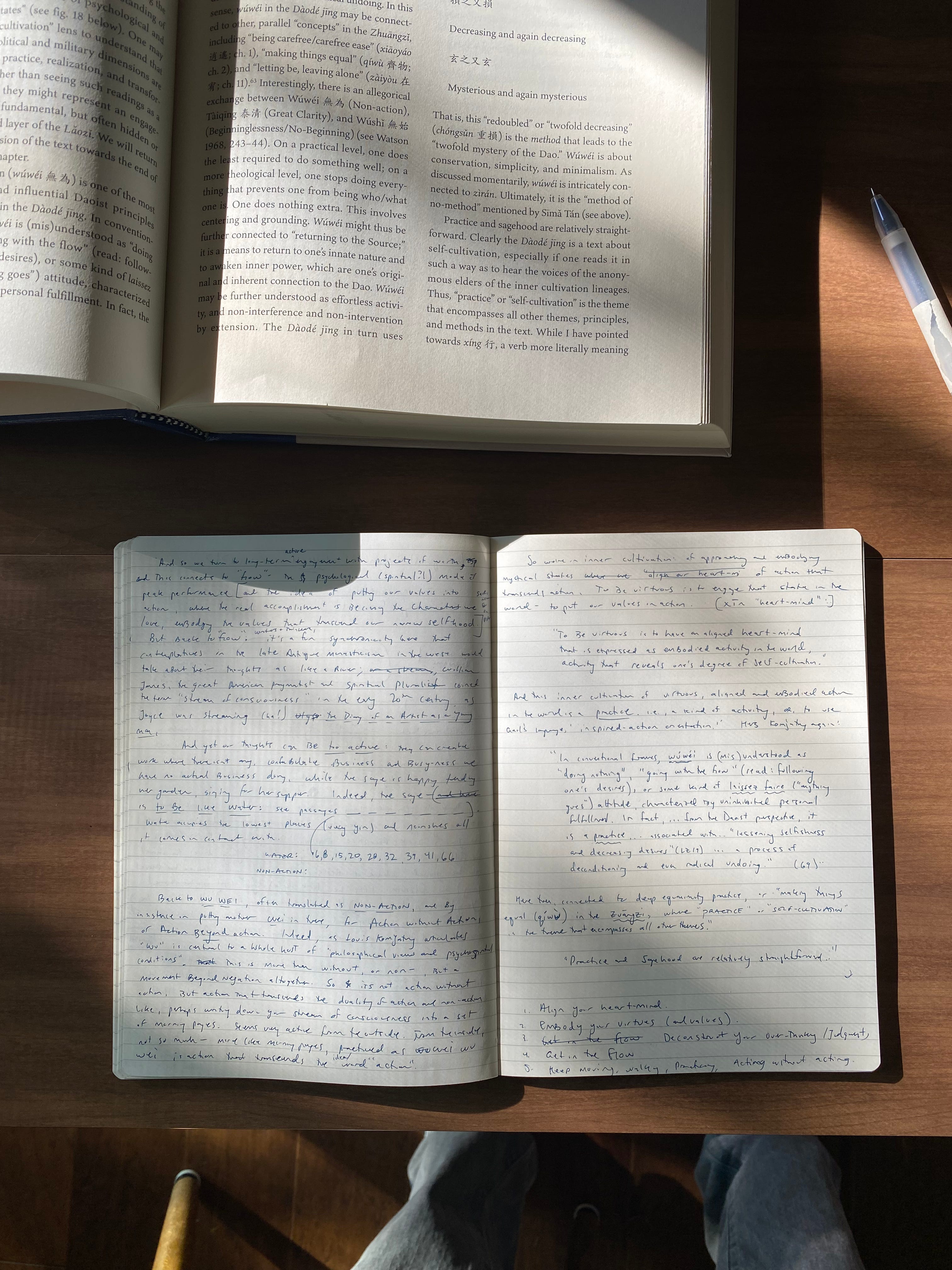
In my pages, I began to connect the Three Treasures from Taoism — deep love, simplicity, humility, with Carl Rogers’ Three Keys to helpful relationships (love, empathy, genuineness) and Robert Kegan’s Three Plateaus of adult development (socialized mind, self-authored mind, self-transforming mind). Each of these frameworks help us understand relation ship-building in a more nuanced and beautiful way. They all relate. And as much as I want to share those relations, I had too-much fun geeking out with my favorite translations of the Tao Te Ching and ran out of time. Also, simplicity :)
The Way of Lao Tzu (Tao Te Ching). Translated by Wing-Tsit Chan. Prentice-Hall Library of Liberal Arts, 1963.
from the “inner cultivation school of early classical Taoism.” Louis Komjathy’s commentary in DaoDeJing: A Contextual, Contemplative & Annotated Bilingual Translation. Square Inch Press, 2023.
Wing-Tsit Chan’ commentary.
John Heider’s liberal translation in the Tao of Leadership: Lao Tzu’s Tao Te Ching Adapted for a New Age. Green Mountain Books, 2015. This one is awesome, too, for leaders, teachers, and facilitators. Boy, does he take some creative liberties.
Heider.
Heider.
From Louis Komjathy’s commentary in DaoDeJing: A Contextual, Contemplative & Annotated Bilingual Translation. Square Inch Press, 2023: “Such an approach may be clarified by observing the universe as transformative process.”